




Current Reports and Press Releases | Archived Reports and Press Releases








Divided Decade: Economic Disparity
at the Century's Turn
By Chuck Collins,
Chris Hartman and Holly Sklar
© United for a Fair Economy, December 15, 1999
The record-breaking economic boom of the 1990s has left Americans more divided at the turn of the millennium. The rising tide has lifted the yachts to tremendous heights, but many Americans are still bailing out their boats after decades of sinking real wages and wealth. Average workers are earning less, adjusting for inflation, than they did a quarter-century ago. The lifeboats of homeless shelters and food banks are overflowing with people caught in the undertow. To make matters worse, the SS America is cruising in a sea of red ink–consumer debt.
In 1989, the United States had 66 billionaires and 31.5 million people living below the official poverty line. A decade later, the United States has 268 billionaires and 34.5 million people living below the poverty line–about $13,000 for a three-person family.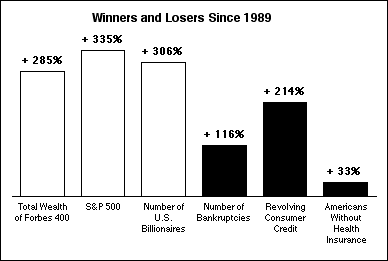
Sources: Forbes 400: Forbes Magazine, through 1999. S&P 500: Standard & Poor’s Corporation, through December 14, 1999. Billionaires: Forbes Magazine, through 1999. Bankruptcies: Administrative Office of the U.S. Courts, through 2Q 1999. Revolving Consumer Credit: Federal Reserve Board, through October 1999. Americans Without Health Insurance: U.S. Census Bureau, through 1998.
At the dawn of the 21st century, the distribution of wealth has regressed to the perilous inequality of the 1920s. The top 1 percent of households has more wealth than the entire bottom 95 percent combined.
Rising Together, Drifting Apart: The Last Half-Century
For a quarter-century after World War II, Americans grew more prosperous and less unequal. Families in every fifth of the nation’s income distribution saw their incomes double. Families in the bottom fifth actually gained income at a faster pace than those at the top.The last quarter-century is a profoundly different story. The top fifth gained while the bottom fifth lost real income. Income inequality reached record levels in the 1990s.
According to the Economic Policy Institute, "Between 1947 and 1973, median family income grew from $20,102 to $40,979, or by 104%. This growth rate worked out to 2.8% a year on average, or a doubling in income every 25 years. After 1973, however, the growth rate…slowed markedly. Over the 24 years from 1973 to 1997, median family income rose an average of 0.35% a year. At this rate, it will take 198 years for family income to double." (1)
Looking at after-tax income puts the growing disparities in even sharper focus. Between 1977 and 1999, the top fifth of households increased their annual income after federal taxes by 43 percent while the middle fifth gained 8 percent and the bottom fifth lost 9 percent. The top 1 percent of households gained 115 percent.
If the middle fifth of households were to receive the same percentage of after-tax income in 1999 that it received in 1977, it would come to $3,500 more per household. Households in the poorest fifth would have $3,300 more–a huge difference for households with a projected 1999 after-federal tax income of only $8,800. (2)
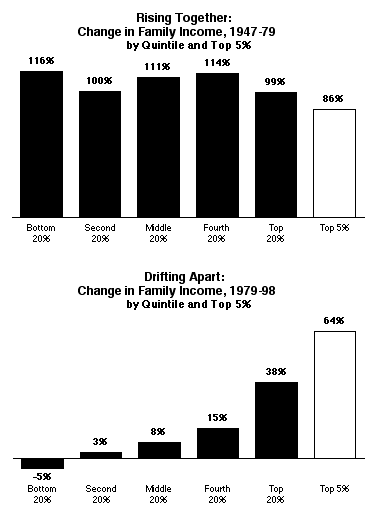
Sources: 1947-79: Analysis of U.S. Census Bureau data in Economic Policy Institute, The State of Working America 1994-95, p. 37. 1979-98: U.S. Census Bureau, Historical Income Tables, Table F-3.
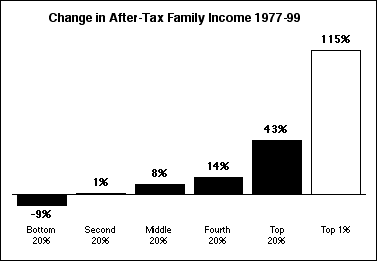
Source: Center on Budget and Policy Priorities, The Widening Income Gulf, September 4, 1999, citing Congressional Budget Office data.
A Sea of Red Ink
The Dow has broken 11,000, but a lot of Americans are just plain broke. They have nothing to tide them over in case of a health crisis or unemployment, much less save for college or retirement. Nearly one out of five households has zero or negative net worth (greater debts than assets). Only one out of ten households had zero or negative net worth in 1962.The nation’s prosperity is cruising precariously in a sea of red ink. Total revolving consumer credit–most of it credit card debt–has more than tripled from $185.9 billion in January 1990 to $584.3 billion in October 1999. (3)
The personal savings rate dropped sharply over the decade. After hovering between 7 and 11 percent for 34 years, the personal savings rate dropped from 7 percent in 1993 to 2 percent in the third quarter of 1999.
Total bankruptcies have more than doubled between 1989 and 1999. Business bankruptcies, on the other hand, are down 36 percent in the same period.
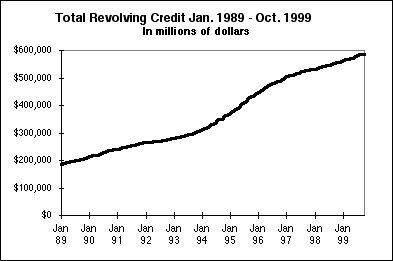
Source: Federal Reserve Board Statistical Release G. 19 Historical Data: Seasonally-Adjusted Consumer Credit Outstanding, December 1999.

Source: Department of Commerce, Bureau of Economic Analysis, November 1999.
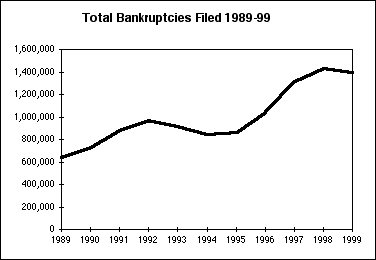
Sources: 1989-94: 1996 U.S. Statistical Abstract, Table 847. 1995-99: Administrative Office of the U.S. Courts news release, August. 6, 1999.
View From the Upper Deck
Since 1977, the top 1 percent of households has doubled its share of the nation’s wealth. The top 1 percent holds 40 percent of the nation’s wealth; the top 5 percent has more than 60 percent. Financial wealth–net worth minus equity in owner-occupied housing–is even more concentrated. The top 1 percent holds nearly half of all financial wealth. (4)Together, the 400 richest Americans are worth more than $1 trillion–about one-ninth of the total gross domestic product (GDP) of the United States, the world’s richest economy. The people in the Forbes 400–they could all stay at New York’s Plaza Hotel at the same time–have about as much wealth as the 50 million households in the bottom half of the population. (5)
Bill Gates is a microcosm of the wealth gap. In 1990, he was worth $2.5 billion, about the same as the gross national product (GNP) of Nicaragua. By the time of the 1999 Forbes 400 he was worth $85 billion, about the combined sum of the GNPs of Nicaragua and all the other countries of Central America–Guatemala, El Salvador, Panama, Costa Rica, Honduras and Belize–plus the Dominican Republic, Haiti, Jamaica and Bolivia. (6)
The pay gap between CEOs and workers is five times wider than it was at the start of the decade, and ten times wider than it was two decades ago. In 1990, according to Business Week, CEOs at large companies made 85 times the pay of average factory workers, up from 42 times as much in 1980. In 1998, CEOs made 419 times the pay of workers ($10.6 million compared with $25,300), up from 326 times as much in 1997. If the CEO-worker wage gap increased this year at the same rate of growth as it did between 1997 and 1998 (28.5 percent), CEOs would make 538 times as much for 1999. In the year 2000, they would make 691 times as much.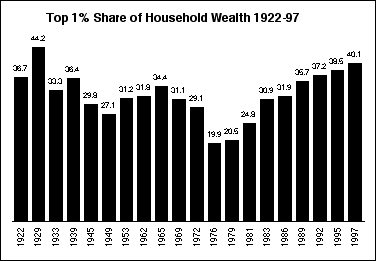
Source: United for a Fair Economy, Shifting Fortunes, p. 10, citing data by Edward N. Wolff.
CEO compensation skyrocketed by 443 percent between 1990 and 1998, while average worker pay increased 28 percent, a little ahead of inflation. A worker who earned $25,000 in 1994 would earn $138,350 today if their pay had grown as fast as the average CEO, according to the AFL-CIO.
But aren’t CEOs generally worth their rich rewards in the booming economy? Not even the Wall Street Journal thinks so. In its 1999 feature on executive pay, the Wall Street Journal observes, "Pay for performance? Forget it. These days, CEOs are assured of getting rich–however the company does." (7)
For Wall Street, the roaring nineties have been a dream come true. The Standard & Poor’s 500 Index generated a cumulative return of 574 percent between January 1, 1989 and December 13, 1999. But the booming stock market has been a bust for many Americans. According to economist Edward Wolff, almost 90 percent of all the stock and mutual fund value owned by households is held by the nation’s richest 10 percent. While stock ownership has been growing significantly, one out of two Americans still don’t own any stock at all.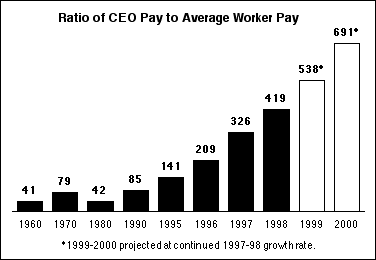
Sources: Business Week, annual surveys of executive compensation; United for a Fair Economy projections.
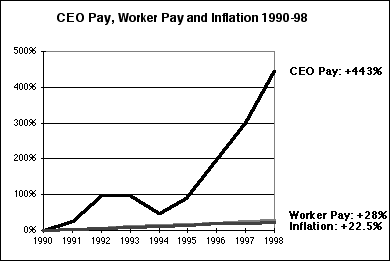
Sources: CEO Compensation: Business Week annual executive pay surveys. Average Worker Pay: Calculated from Bureau of Labor Statistics, "Average Weekly Earnings of Production Workers." Inflation: Bureau of Labor Statistics, Consumer Price Index, All Urban Consumers (CPI-U).
Cumulative and Annualized Return
Dates Cumulative Annualized
on the S&P 500 Stock Index
Jan. 1, 1989 - Dec. 13, 1999 574.1% 19.0%
Jan. 1, 1990 - Dec. 13, 1999 412.2% 17.8%Source: Bloomberg L.P. Standard & Poor’s 500 Index is capitalization weighted with dividends reinvested. Annualized figures are derived from compounded quarterly returns.
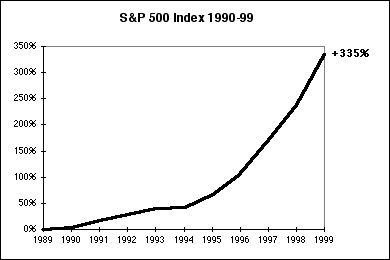
Sources: 1990-98: Standard & Poor's Corporation, cited in 1999 Economic Report of the President. 1999: figure is through December 14, 1999.
Still Bailing Out Their Boats
While the top 1 percent was becoming more fabulously wealthy, the typical American was stagnating. At about $50,000, the real net worth of the American household in the middle is lower than it was at the decade’s start. The inflation-adjusted net worth of the median household fell from $54,600 in 1989 to $49,900 in 1997 (the latest figure available). (8)Median household income reached a new high of $38,885 in 1998. Unfortunately, it’s not much higher than it was in 1989, adjusting for inflation, despite longer work hours and increased productivity. Hispanic households actually had lower real 1998 median incomes, at $28,330, than they did in 1989. Black household income went up, but was still very low at $25,351. (9)
The economic boom is on the verge of becoming the longest in U.S. history. But typical workers are still catching up with the wages their counterparts made a quarter-century ago–despite higher educational attainment and productivity. A worker earning $25,000 in 1998 would have made about $1,060 more in 1973 (also a time of low unemployment), adjusting for inflation.
Productivity grew 46.5 percent between 1973 and 1998, but the gains were not shared with average workers. (10) What if wages had kept rising with productivity, and were 46.5 percent higher in 1998 than they were in 1973? The median hourly wage would have been $17.27 in 1998, rather than $11.29. That’s a difference of $5.98 an hour–or $12,438 a year for a full-time, year-round worker. Recent wage growth has already slowed significantly despite continued low unemployment, a sign perhaps of renewed wage stagnation. (11)
The government helped sink workers by leaving the minimum wage unchanged or changed inadequately as inflation eroded its value. The minimum wage used to bring a family of three with one full-time worker above the poverty line. Now it doesn’t bring a full-time worker with one child above the poverty line. The real value of the minimum wage went up in the 1990s, but it’s still down 27.0 percent since 1968.
Men had a lower median income in 1998 than they did three decades ago, in 1969, adjusting for inflation. If not for men and women’s increased work, families would be far worse off. Women’s labor force participation rate jumped from 43 percent in 1970 to 60 percent in 1998. Unfortunately, women who work full time earn only 73 cents for every dollar earned by men.
Mothers in married couple families increased their average annual paid work by 223 hours–nearly six weeks–between 1983 and 1997. Fathers increased their work by 158 hours–four weeks–in the same period. Americans work longer hours than workers in other industrialized nations. (12)
While college graduates have fared much better than those without a college education, the typical graduate has not fared well in historical terms. The entry-level wages of college graduates fell in the early and mid-1990s and have only recently returned to their pre-recession 1989 level.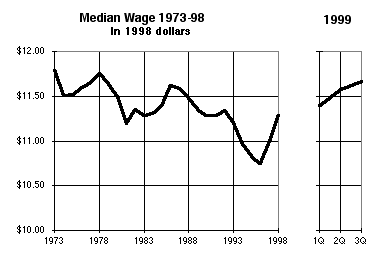
Source: Economic Policy Institute analysis of U.S. Census Bureau, Current Population Survey Outgoing Rotation Group data.
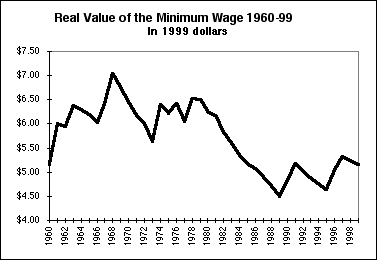
Source: Economic Policy Institute. Entire series adjusted to 1999 dollars by United for a Fair Economy using the Consumer Price Index for all Urban Consumers (CPI-U).
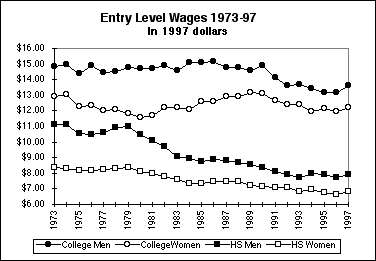
Source: Economic Policy Institute, 1999.
A Rising Tide Doesn’t Lift All Boats
You know something’s wrong when the economy’s been good for so long and it’s still so bad for so many people. The official poverty rate is a little lower than it was a decade ago, but it’s still higher than it was in the 1970s. Even married couple families have higher poverty rates today than they did in the 1970s, despite women’s greatly increased hours on the job.One out of eight Americans lives below the official poverty line–just $8,316 for one person and $13,003 for a family of three–including one out of four Blacks and Hispanics, and one out of five children. (13)
The percentage of people in extreme poverty–less than 50 percent of the poverty level–rose from 4.9 percent in 1989 to 5.1 percent in 1998, and is way up from 1975, when it was 3.7 percent. (14)
The ranks of those without health insurance swelled during the decade, rising from 13.6 percent in 1989 (33.4 million people) to 16.3 percent in 1998, or 44.2 million people. According to a report released by the Health Insurance Association of America, the nation’s leading health insurance trade association, "The primary predictor of health insurance coverage is income. Lower income Americans are most likely to be uninsured. However, as health care costs have continued to rise as a percentage of family incomes, health insurance coverage is becoming unaffordable for more middle income Americans." (15) Lack of health insurance often means inadequate health care and is associated with a 25 percent higher risk of death (adjusting for physical, economic and behavioral factors). (16)
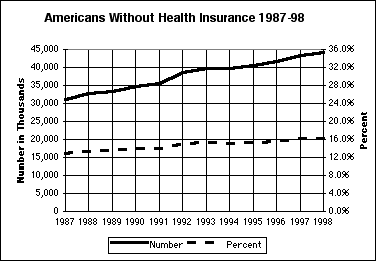
Source: U.S. Census Bureau, Table HI-1, "Health Insurance Coverage Status and Type of Coverage by Sex, Race and Hispanic Origin: 1987 to 1998."
Why the Wealth Gap Matters
Enduring prosperity is not built on rising debt and disparities. Growing economic inequality is not healthy for families, communities, our economy or our democracy.A recent survey of leading urban historians, planners and architects for the Fannie Mae Foundation has identified "growing disparities of wealth" as the single most important influence that will shape American metropolitan areas over the next 50 years. (17)
Many public opinion polls now rate education as the number one concern of American families. Headlines regularly trumpet the wide gaps between white and minority student test score achievement–even among students of the same family income levels. But where income cannot explain the test score gap, wealth disparities can. As Yale sociologist Dalton Conley has shown in his new book Being Black: Living in the Red, if the test scores of black students are compared to the scores of white students with the same family wealth, the achievement gap between black and white students disappears.
Wealth and income disparities also greatly affect public health. There is growing evidence from epidemiologists around the world that the greatest danger to public health may be a malady that medical schools never address: inequality. Studies that have compared nations, states within the United States, and metropolitan areas within the United States have all concluded that mortality rises with inequality, affecting rich as well as poor and middle class. As a report in the American Journal of Public Health found, higher income inequality is associated with increased mortality at all per capita income levels. "Given the mortality burden associated with income inequality," the report concludes, "business, private, and public sector initiatives to reduce economic inequalities should be a high priority." (18)
Concentrated wealth is concentrated political power. According to the Center for Responsive Politics, some 80 percent of all political contributions now come from less than 1 percent of the population. If the Congress were truly representative of the people we would have implemented campaign finance reform by now. Big donor contributions to political campaigns are the obvious, but certainly not the only, example of how wealth holders exert inordinate influence on our democratic institutions.
Asset-building policies have been an integral part of U.S. history from the Homestead Act in the 19th century to the G.I. Bill and subsidized mortgage programs in the post-World War II era that widely expanded college access and homeownership. Because of widespread racial discrimination in the administration of these programs, many people of color did not get on the asset-building train, an important factor in the vast racial disparities in wealth today.
The Course Ahead
It’s time for our nation to make a renewed commitment to the kind of asset-building policies that will strengthen prosperity in the future. Here are some key elements of an Asset-Building Agenda for the 21st Century:Dedicated Tax Exempt Savings Programs: An effective way of promoting savings and asset building is through Individual Retirement Accounts, which exempt accounts from taxation at the front end or, like the Roth IRA, from the back end. Similar accounts have been proposed to enable people to save for homeownership. Today, individuals can withdraw, without penalty, $10,000 from an IRA for a first time home purchase. A tax credit for college education went into effect this year. Over the long run, we should make sure that tax policies encourage access to higher education and asset building by low- and middle-income Americans rather than disproportionately subsidizing wealthier Americans.
Individual Development Accounts (IDAs): IDAs are like individual retirement accounts (IRAs), but are targeted to low- and moderate-income people. Participants in IDAs may have their tax-free deposits matched by public or private dollars. A number of private charities have financed pilot IDA programs through community-based organizations. A large-scale publicly funded IDA program, with matching funds based on income, would provide significant opportunities for asset-poor households to build wealth. Participants could withdraw funds from IDAs in order to purchase a home, finance a small business, or invest in education or job training. Even small amounts of money can make a substantial difference in whether or not individuals get on the asset-building train. (19)
USA Accounts: President Clinton has introduced a version of individual retirement accounts called Universal Savings Accounts. The president’s proposal is to invest 10 percent of the total budget surplus over the next 15 years to match the contributions of low- and moderate-income workers in private accounts. It includes a flat annual tax credit per worker and a 50 to 100 percent matching contribution on a worker’s own contributions, up to a specified limit. Both the credit and the matching rate would be reduced for those with higher incomes.
KidSave Accounts: KidSave legislation introduced by Senator Robert Kerrey (D-NE), with bipartisan support, would guarantee every American child born in 1995 or later $1,000 at birth, plus $500 a year for children ages one to five, to be invested until retirement. Through compound returns over time, the account would grow substantially, provide a significant supplement to Social Security and other retirement funds, and enable many more Americans to leave inheritances to their children. That would strengthen opportunities and asset building across generations. "Under our proposal, every baby in America would enter life owning a piece of their country," said Kerrey. "The result isn’t just more retirement security. It’s also an opportunity to transform an ‘us-vs.-them’ economy–in which good news for the wealthy often seems to be bad news for everyone else–to a ‘we’re all in this together’ economy."
Expand Earned Income Credit and Raise Minimum Wage and No-Tax Threshold: The minimum wage must be raised to set a realistic foundation for everyone to build on. The Earned Income Credit has won the praise of liberals and conservatives alike. The Credit is targeted to very low-income working families and could be expanded to be both larger in amount and available to more households. Expanding the "No Tax Threshold" and/or expanding the personal exemption would increase the amount of income people could earn before it is subject to taxation.
Affordable Housing: Owning a home is the primary asset for most Americans and has long been considered a stepping stone to building additional assets. Public policies that increase access to homeownership include subsidized mortgages and mortgage insurance, down payment assistance funds, second mortgage subsidy programs, and grants and low-interest loans for home improvements. Stricter enforcement of fair housing and community reinvestment laws would remove barriers to homeownership and asset-building for people of color.
Homeownership is not the only tenure option that should be promoted, however, as it is not appropriate for all households at all stages of life. Nor should homeownership be considered the only "asset account" and "line of credit" for low- and moderate-income families, as it has many risks. A large and growing percentage of the population live in mobile homes or neighborhoods that do not have appreciating property values. (20) Access to decent and affordable cooperative and rental housing would enable many people to save and meet other financial security goals.
Broadening Employee Ownership: While the overall trend of wealth growth has been toward concentration, a significant exception is found among employee owners. As of 1998, more than 8 percent of total corporate equity was owned by non-management employees, up from less than 2 percent in 1987. This ownership takes the forms of Employee Stock Ownership Plans (ESOPs), profit-sharing plans, widely granted stock options and other forms of broad ownership. In 1997, according to the National Center on Employee Ownership, the average employee owner had about $35,000 in corporate equity, disregarding what they were able to save from their paychecks.
Several studies have concluded that firms with significant employee ownership grow faster and have lower turnover. A recent study by Hewitt Associates and the Kellogg School of Management at Northwestern University found that between 1971 and 1991, companies with ESOPs had total stock returns that averaged 6.9 percent higher in the four years after the ESOP was set up than similar firms without ESOPs. Public policy can encourage employee ownership through government purchasing, licensing rights, public pension plan investments, loans and loan guarantee programs, and so on.
Progressive Tax Rates: The next Congress should pass tax reform that restores progressivity rather than reduces it further. For example, the "10 percent" tax plan advanced by House Minority Leader Richard Gephardt (D-MO) taxes all types of income at the same rate, whether from wages, capital gains, dividends or interest. The plan raises the no-tax threshold and has progressive tax rates starting at 10 percent–the rate most Americans would pay.
Maintain Strong Estate and Inheritance Taxes: Government policies should facilitate the transfer of substantial family assets from one generation to the next. But we should also be concerned about excessive wealth transfers and their distorting impact on the economy, democracy and culture. At very high levels, particularly in households in the top 1/2 percent with assets in excess of $10 million, the transfer of wealth represents a transfer of power, not simply the means to lead a decent life. Only a small share of households (about 2 percent) pay estate taxes today because only estates over $625,000 at the time of death are subject to the tax (the threshold is being raised incrementally to $1 million), and there are safeguards for family farms and family-owned businesses. With planning, married couples can already pass a minimum of $1.2 million to their heirs free of any estate tax. Estate taxes should not be reduced, much less repealed, as some propose.
Taxing Capital Gains Like Wages: The tax burden has been increasingly shifted off of large asset owners and onto wage earners. The Social Security payroll tax has taken an increasingly bigger bite out of the paychecks of most wage earners, especially low- and middle-wage earners since income subject to Social Security tax is capped. Many workers now pay a higher tax rate on income from wages than wealthy investors pay on realized capital gains. Taxing income from assets and income from wages at the same rate would foster greater equity. In the words of billionaire investor Warren Buffet, speaking at the 1997 annual meeting of his company, Berkshire Hathaway, "The capital gains tax rate is just about right. I don’t think it’s appropriate...to have me taxed at 28 percent if I sell my Berkshire shares when someone who’s trying to find a cure for cancer is taxed at 39 percent." And that was before the 1997 capital gains tax cuts–lowering the long term capital gains rate to 20 percent–went into effect.
© United for a Fair Economy and Holly Sklar, 1999.
- Economic Policy Institute, "Family income finally regains 1989 level," Economic Snapshot, week of February 3, 1999.
- Isaac Shapiro and Robert Greenstein, The Widening Income Gulf, Center on Budget and Policy Priorities, Washington, DC, September 4, 1999.
- Federal Reserve Board, Historical Release G-19: Consumer Credit-Seasonally Adjusted.
- Chuck Collins, Betsy Leondar-Wright and Holly Sklar, Shifting Fortunes: The Perils of the Growing American Wealth Gap (Boston: United for a Fair Economy, 1999), citing Edward Wolff’s analysis using the Federal Reserve Survey of Consumer Finances.
- Forbes 400 1999 and Shifting Fortunes, citing Edward Wolff.
- Forbes 400 1990 and 1999; World Bank GNP data.
- Joann S. Lublin, "Lowering the Bar," Wall Street Journal, April 8, 1999.
- Shifting Fortunes, citing Edward Wolff.
- U.S. Census Bureau, Money Income in the United States 1998, September 1999.
- Data provided by Economic Policy Institute, December 14, 1999.
- Economic Policy Institute, Jobs Fax, December 1999.
- Diane Lewis, "Women’s gains tied to jump in incomes," Boston Globe, March 17, 1999; International Labor Organization; Economic Policy Institute.
- U.S. Census Bureau, Poverty in the United States 1998, September 1999.
- U.S. Census Bureau, Historical Tables, "Percent of People By Ratio of Income to Poverty Level: 1970 to 1998."
- William S. Custer and Pat Ketsche, Health Insurance Coverage and the Uninsured: 1990-1998, Health Insurance Association of America (HIAA), Washington, DC, December 1999, pp. 2-3 and HIAA press release, December 8, 1999.
- Linda J. Blumberg and David W. Liska, The Uninsured in the United States: A Status Report (Washington, DC: Urban Institute, April 1996) and Spencer Rich, "For Those with Modest Incomes, Health Insurance Bill is Little Help," Washington Post, May 3, 1996. Also see Dennis P. Andrulis, "Access to Care is the Centerpiece in the Elimination of Socioeconomic Disparities in Health," Annals of Internal Medicine, September 1, 1998 and Roni Rabin, "Queens Health: Taking a Risk Living Without a Safety Net: Insurance a Key to Healthy Lives, but Many Have None," Newsday, November 15, 1998.
- Fannie Mae Foundation, The American Metropolis at Century's End: Past and Future Influences, September, 1999.
- John W. Lynch, George A. Kaplan, Elsie R. Pamuk, et al., "Income Inequality and Mortality in Metropolitan Areas of the United States," American Journal of Public Health 88, July 1998; "A Modern Tale of 282 Cities…Exposes America’s Hidden Virus," Too Much, October 1998. International Health Program, University of Washington and Health Alliance International, "Health and Income Equity," (http://weber.u.washington.edu/~eqhlth/).
- Michael Sherraden, Assets and the Poor: A New American Welfare Policy (Armonk, NY: M.E. Sharpe, 1991) and Michael Sherraden, Deborah Page-Adams, and Lissa Johnson, Start-Up Evaluation Report: Downpayments on the American Dream Policy Demonstration (Center for Social Development, Washington University in St. Louis: January 1999).
- Dalton Conley, Being Black, Living in the Red: Race, Wealth and Social Policy in America (Berkeley: University of California Press, 1999).


 UFE
Home | About UFE
| Press Room | Activist
Network | Economics
Education | Research
Library
UFE
Home | About UFE
| Press Room | Activist
Network | Economics
Education | Research
Library
Events | Links | | Responsible Wealth | Join UFE | Contact UFE | Order Materials
United for a Fair Economy, 37 Temple
Place, 2nd Floor, Boston, MA 02111. Voice: 617/423-2148 Fax: 617/423-0191.
Copyright 1999 United for a Fair
Economy. All rights reserved.